
Saving money always sounds like such a good idea — that is, right up until real life starts acting like real life.
If you’re like most people, you probably start your month very motivated and 100% certain you’re going to stick to your savings goal this month.
Then suddenly, amazon makes it’s presence known. You’re buying takeout because you’re just too tired to bother. Your grocery bill looks insane and that one, quick little treat becomes three . . . or ten.
And before you know it the whole idea of saving money just feels totally out of reach, because there’s nothing left to save!
Been there. So many times I can’t even count.
The good news?
You can actually save that money with a few little neat tricks. And I’ll share with you how it’s possible to save $500 in a month in this post.
And no, saving $500 in a month does not require you to do extreme coupon clipping, survive in misery, or pretend that buying coffee is some kind of moral failure.
It just requires a realistic plan for the next few weeks.
That plan mostly requires you to put a stop to those consistent, quiet leaks where your money keeps slipping away when you’re not really paying attention.
And, that is exactly what this 30 day $500 savings challenge is meant to help you do.
What Is The Save $500 In A Month Challenge?
This is a simple challenge with a simple goal: Save $500 in 30 days.
If you break this down, that looks like:
- $125 per week or around $16–$17 per day
It seems like a lot when you look at it like that right? It may even seem a little aggressive, but you’ll be shocked to see how you’re leaking this money. Every. Single. Day.
These little leaks—they really add up at the end of the day—usually happens through a series of very small decisions that add up surprisingly fast.
Things like:
- Spending a little too much or too often on conveniences
- Making too many extra grocery runs instead of using the groceries you already bought
- Paying for unused or under-used subscriptions every month
- Making too many impulse purchases
That kind of thing seems so harmless, but before the month is over, you’re literally spending hundreds that could have been otherwise saved up.
So no, this isn’t one of those “stop buying lattes and suddenly you’re wealthy” conversations—although there is a bit of that.
This is about being intentional for just 30 days so you can keep your money right where you need it … or want it.
Is Saving $500 In One Month Actually Realistic?

For many people?… Yes.
But that mostly depends on your income, your expenses, and of course, your current spending habits and what you’re willing to do about it.
Also, it’s important to note that if your budget is already stretched painfully thin, saving $500 in a month might not be realistic right now—and that’s okay. We can find something else for you! Like maybe a $200 savings challenge perhaps.
But if you just have too many spending leaks, too much convenience spending, too many unused subscriptions, or you have that pesky habit of making too many random impulse purchases?
Then this savings challenge is right up your alley.
| Day | Amount to Save | Total Saved |
| Day 1 | $5 | $5 |
| Day 2 | $10 | $15 |
| Day 3 | $15 | $30 |
| Day 4 | $20 | $50 |
| Day 5 | $25 | $75 |
| Day 6 | $10 | $85 |
| Day 7 | $15 | $100 |
| Day 8 | $20 | $120 |
| Day 9 | $20 | $140 |
| Day 10 | $10 | $150 |
| Day 11 | $15 | $165 |
| Day 12 | $25 | $190 |
| Day 13 | $20 | $210 |
| Day 14 | $10 | $220 |
| Day 15 | $20 | $240 |
| Day 16 | $15 | $255 |
| Day 17 | $20 | $275 |
| Day 18 | $25 | $300 |
| Day 19 | $10 | $310 |
| Day 20 | $15 | $325 |
| Day 21 | $20 | $345 |
| Day 22 | $20 | $365 |
| Day 23 | $10 | $375 |
| Day 24 | $25 | $400 |
| Day 25 | $15 | $415 |
| Day 26 | $20 | $435 |
| Day 27 | $20 | $455 |
| Day 28 | $10 | $465 |
| Day 29 | $20 | $485 |
| Day 30 | $15 | $500 |
So, now that you’ve decided, how do you find all this extra money to save?
Where To Find $500 Without Making Yourself Miserable
It shocks me—and I’m sure it shocks you too—how easy it is to spend (waste?) hundreds of dollars on things you don’t even remember buying when it’s all said and done.
And because it’s so easy to spend (waste?) said money, most people tend to assume that simply saying, “I’ll just spend less money this month,” will magically help them save it.
But it doesn’t always work like that. Cause, I’ve found that the things that aren’t good for you are usually the easiest things to stick to. But the things that are good to do—like eating better, exercising regularly, and saving your money—take deliberate, concerted effort to stick to. So you need a more actionable plan. Not just a vague promise to spend less that you probably won’t keep past the first week.
Here’s how to make it as easy as possible in the next 30 days.
1. Cut Back On Takeout (Even Temporarily)

Listen. I know I’m asking you to do something kind of hard here since this is always one of the hardest things for me to cut back on too.
But it’s not for forever and it’s important to take a look at this because takeout has a sneaky way of draining money ridiculously fast.
One dinner here ($18).
One work lunch there ($12).
A random coffee stop ($6).
A snack because you were already out ($4).
Do that a few times throughout the month, and somehow that little $40 expense ($40 × 5) turns into $200!
Even temporarily cutting back on takeout for the month (or reducing it by half) can help you save a surprising amount. That’s roughly between $100 to $250+ depending on your takeout habits.
P.S. I actually do feel miserable when I can’t get my takeout, but it’s only for one month, so let’s be brave here, shall we?
Something that helps a lot here is making sure future-tired-you has food at hand. Nothing else works.
I mean, most of us aren’t ordering takeout because we love wasting money. We’re ordering takeout because on some days, we’re hungry, tired, and the idea of spending even 30 minutes making a meal feels like more effort than it’s worth.
That is why saving a few leftovers, quick lunches, chopped ingredients, or emergency meals ready to grab can make it much easier to skip that expensive takeout order.
Now look, not every Amazon package is a cry for help.
Some of them are interventions.
Because there is a very specific kind of chaos that happens when you have perfectly good food at home, but it’s hidden in the fridge in an old pot under foil, so naturally your brain decides takeout is the only reasonable option.
This is for that version of us.

These glass food storage containers are great for prepping easy lunches, storing leftovers, chopping ingredients ahead, or keeping a few grab-and-go meals ready for busy days. The clear, leak-proof design makes it easier to see what you have, use up food before it goes bad, and make eating at home feel a little more doable.
And of course, you can always try making your favorite takeout-style meals at home if you really, really can’t do without them.
2. Do A Subscription Audit
Subscriptions are sneaky little thieves that seem to be the most overlooked.
Things like streaming services, apps, forgotten free trials, memberships you meant to cancel six months ago, and that one $9.99 monthly charge you keep meaning to deal with but somehow never do … yeah, they’re all quietly draining your money while you’re not even paying attention.
So take some time to go through your statements and figure out if you really need them. If not, cancel them asap and keep your money.
By cancelling a few subscriptions, you can save anywhere from $40 to $100 without changing your day to day.
3. Grocery Shop With a Plan
A lot of money gets wasted on grocery trips. But you can avoid spending that money if you go in with a real plan of what you’re doing. So think about:
- what breakfast looks like for the next few days (or the upcoming week)
- what lunches will be
- what dinners you’re making
- what snacks you already have (or genuinely want)
- what needs to be used before it goes bad in the fridge
Otherwise you’ll probably end up buying random food that sounded good in the moment… and then still ordering food later because “there’s nothing to eat.” This is the cycle for many people:
buying too much without meals in mind → wasting that food → ordering takeout anyway
I personally do my grocery shopping every Saturday or Sunday, and because I mostly eat the same kinds of meals, I keep the process really simple. Here’s the little money-saving routine I use:
- Step 1: I take stock of what’s already in my pantry, freezer, and fridge, then make a quick note of what I have.
- Step 2: I decide what I want to eat for each meal for the coming week, usually Sunday through Friday.
- Step 3: I write down every ingredient I need for those meals, plus any snacks I know I’ll actually eat.
- Step 4: I go to the store with my list in hand, a set grocery budget in mind, and stick to both as much as possible.
- Step 5: I do my best to dodge all the prettily packaged foods and snacks calling my name from the shelves—the ones that look harmless but will absolutely wreck my savings goal.
Potential savings here: $75 to $200+
4. Try A No-Spend Week
Now let’s move on to my second least favorite place to find extra money — because unfortunately, it actually works.
A no-spend week.
A no-spend week sounds a bit intense doesn’t it? But it doesn’t have to be that dramatic.
It just means pausing unnecessary spending for a short while. You still buy essentials and live your life… just with fewer shocking moments of spending close to $100 on random items you don’t really need.
No spend simply means you’ll avoid things like:
- impulse shopping
- random Amazon purchases
- convenience snacks
- emotional spending
- “just because” buys
This is where is one of the main things that’ll help you realize how much you tend to spend without even thinking about it. And again, it’s for one week!
Potential savings: $50 to $150+
Sometimes even more!
5. Sell Things You’re Not Using

This is one of the least painful ways to find money for your savings fast.
And most people have way more sellable stuff than they think. In fact, some resale and decluttering estimates suggest the average household has of $1,000–$3,000 worth of unused items sitting around.
Sellable things include:
- clothes
- shoes
- handbags
- small furniture
- kitchen gadgets
- baby items
- electronics
- decor
- beauty products (unused and unopened)
- exercise equipment
Facebook Marketplace can be great for this. Also, resale apps or local buy/sell groups.
Even a few small sales can quickly add up.
Potential savings: $50 to $300+ this month.
6. Add a 24 Hour Pause Rule
This one helps a lot with emotional spending. So, before buying anything non-essential, wait 24 hours.
That’s it.
You’ll find that sometimes you genuinely need the thing. But most of the time you just needed dopamine. And there is a big difference here.
A shocking number of your must-have purchases stop feeling urgent once you let the decision sit for a little while.
My 6 Realistic Tips on How To Save $500
- Cut takeout: $150
- Cancel subscriptions: $60
- Sell unused items: $140
- Grocery savings: $100
- Impulse spending avoided: $50
Total:
$500
That suddenly feels a lot less terrifying, than when you started reading the post doesn’t it?
This is all because it’s went from being one impossible giant number, to a bunch of smaller, more manageable decisions that are right within your grasp.
Why People Usually Fail Challenges Like This
The methods above show just how possible (or dare I say… easier?) it is to make this $500 savings challenge a reality.
But, still, most people tend to fail when it comes to challenges like this. Here’s the most common failure points and how you can avoid them.
Trying To Be Perfect
For many many people, one spending mistake happens and they think that the whole month is already ruined.
So they quit. I used to be like this.
Please do not do that.
One bad day does not erase the entire challenge. It’s like having one off meal or one cheat day — annoying, yes, but not powerful enough to undo all the other days you actually showed up and tried.
Because getting it right for 25 days and messy for 5 still means you spent most of the month doing it right and that counts.
So, if you’ve fallen off, pick yourself back up the day after you’ve made said mistake and continue with your plan.
Making It Too Extreme
If you’re doing a savings challenge that feels like punishment, it’s so much easier to give up on it.
Therefore, if $500 is too much for your current budget, reduce it. Maybe you’ll do better with saving $250 or $300 in 30 days instead. This is still pretty great.
Also, lean into the method/s above that you can do well ‘re good at, rather than those you keep failing at. For example, If you’re no good at no-spend days or weeks. But you rock at managing your grocery spending or selling items for extra cash (that you actually save) then lean into that.
Not Tracking Anything
Awareness can help you change your behavior fast.
If you have no idea where your money is going, fixing any money problems becomes that much harder. Even if you just use a rough monthly budget, it can help you spot spending leaks you may not have noticed before.
And while you’re at it, track the money for this challenge too.
That’s exactly why I created the free printable $500 savings challenge tracker above.
I think there’s something weirdly satisfying about physically coloring in, ticking off, or crossing off each day as you make progress. It makes the challenge feel real.
Another thing I also strongly recommend is physically separating the money you plan to save from the money you normally spend.
Because when money feels tight, it becomes very easy to “borrow” from yourself. Ask me how I know this.
Personally, I like to put my challenge money into a jar and literally seal it shut with super glue.
I know that may be slightly dramatic. But I never regret doing this because removing easy access removes temptation for me … it might for you too.
If the super-glued hostage jar method feels a little intense, a simple budget binder or cash envelope wallet can do the same job while making it easier to track where your money is going.
Plus, seeing your savings grow can be incredibly motivating.

This SKYDUE Budget Binder is perfect if you prefer cash savings because you can separate your money into zipper envelopes and label each one by category or goal. Use it for your 30 day savings challenge, grocery budget, bill money, sinking funds, or weekly spending cash.
It makes the challenge feel more visual and satisfying because you can watch each envelope fill up as you save.
Ignoring Emotional Spending
Stress spending is real.
Boredom spending is real.
“Honestly, I’ve had a rough day and deserve this” spending is extremely real.
“My period is on it’s way and I’m exhausted, irritable and want to order/buy everything I’m craving” spending is so so real.
I’m saying all this to say that you have to notice your triggers and prepare for them in advance.
For example, keep a few easy prepared meals in the fridge so you’re not relying on takeout on the nights you’re too tired to cook.
And if you know your cravings usually kick in before your cycle, plan for that too. Stock up on a few of your favorite snacks, quick meals, or comfort foods ahead of time, so you can satisfy the craving without turning it into a budget-breaking food run.
The goal is not to pretend your emotions, cravings, or tired days do not exist because they do and they can hurt your pockets. Instead it’s to plan for your real life, so those moments don’t keep making spending decisions for you.
Free Printable $500 Savings Tracker
If you’re doing this challenge, I made a free printable 30 Day $500 Savings Challenge tracker to help you stay on track.
Because checking things off somehow makes us feel wildly accomplished, and honestly… it works.
Want A Full Money Reset Instead?
If saving $500 is part of a bigger goal—and you want more structure than a simple tracker—my full 30 Day Money Reset Planner was made for exactly that.
It includes pages that can help you to:
- track bills
- review spending
- do no-spend challenges
- plan meals to reduce overspending
- identify spending triggers
- choose bigger savings goals
- stay accountable all month
Because sometimes what we actually need is not just motivation, but a system we can follow.
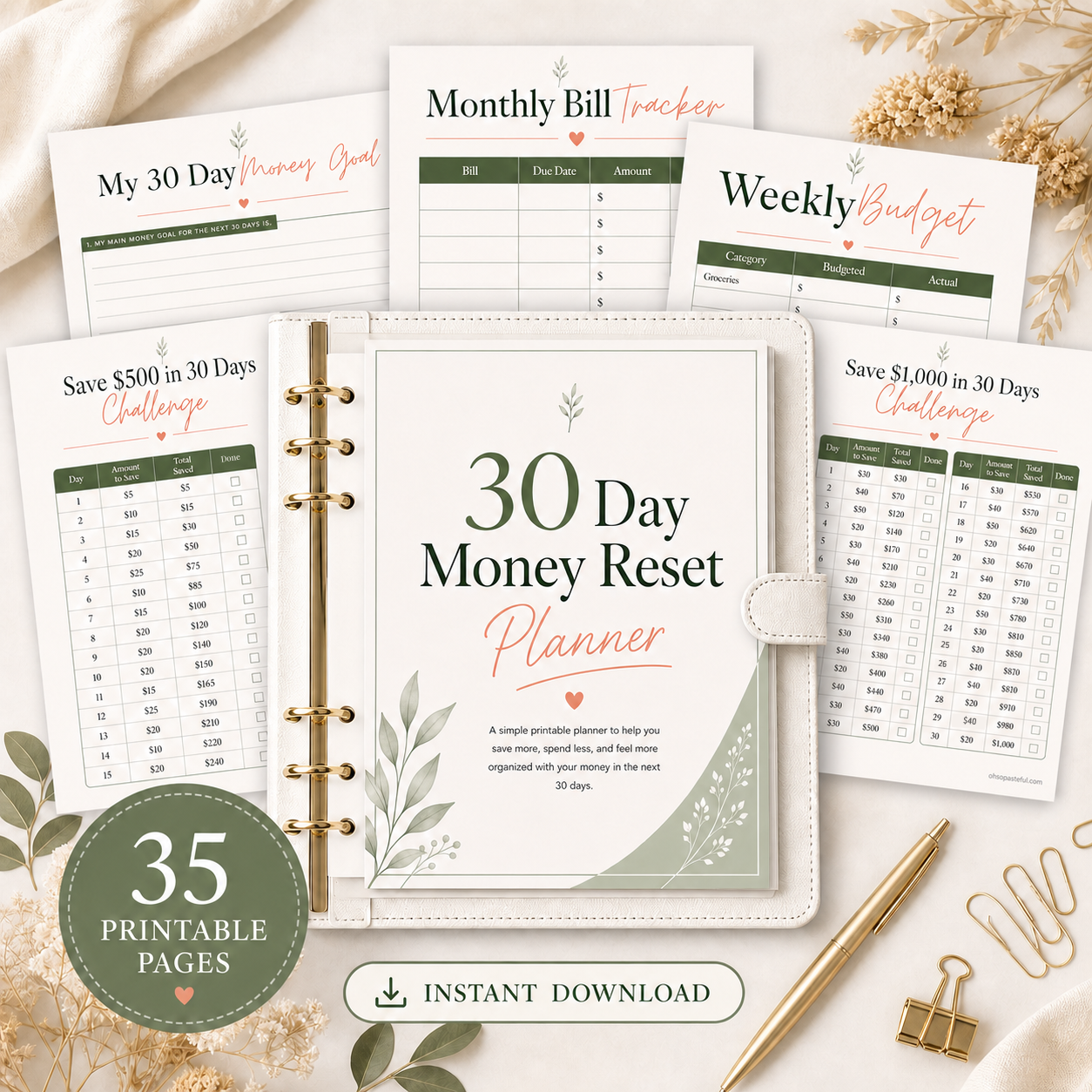
Ready to do more than just save money for 30 days? The 30 Day Money Reset Planner helps you track your spending, plan your bills, cut back on impulse buys, choose a savings challenge, and feel more in control of your money by the end of the month.
It includes budget pages, spending trackers, savings challenges, no-spend pages, weekly check-ins, and reflection pages so you’re not just guessing your way through the challenge.
Saving $500 in a month might sound like a lot, but if you break it down into small, realistic changes, you see that it is much more doable than you think.
Without making yourself miserable, surviving on instant noodles, or saying no to every little thing that makes life enjoyable, you can start being more intentional with your money, cutting back where it actually makes sense, and proving to yourself that small choices really do add up.
And while some weeks will be easier than others, and you might slip up, order takeout, grab the random coffee, or have one of those “I’ve had a day” spending moments. That’s normal. Because you’re not trying to be perfect. You’re simply trying to make some progress.
Also, even if you don’t hit the full $500 in those 30 days, saving $400, $300 or even $200 is still money you didn’t have before.
Everyday…or most days… just try to make a few smarter choices, be a little more aware, and probably try for fewer mysterious Amazon packages showing up at your door.
That part helps too.