
Saving $6,000 in six months sounds almost insurmountable when you first hear it. I mean with the prices the way that they currently are, who has that kind of money to put away right?
It’s such a big goal, that it might make you immediately start doing the math in your head and then quietly closing the tab. Because again, who has that kind of money to save in those times we live in? Most people are barely even staying afloat as it is…much less with this huge 6 month savings goal.
The truth is that you can actually do it if you break it down in smaller, more realistic steps.

And you won’t need to do any extreme couponing, cut out all of your favorite things or eat plain rice for six months — and I’ll walk you through it in 6 simple steps.
Because the point isn’t just to save money for the sake of saving money. It’s to give that money a real job.
And this money is nice to have for an emergency fund, a vacation, a move, a wedding, a car repair that always seems to happen at the worst possible time, or simply to have in your bank account so you can stop feeling stressed all the time.
What Does Saving $6,000 In 6 Months Actually Mean?
Six months is approximately 26 weeks. Therefore, if you’re paid every two weeks, you’ll receive about 13 paychecks during that time.
That means:
$6,000 ÷ 13 paychecks = approximately $462 per paycheck
I know, I know. Seeing that number can feel somewhat intimidating.
But here’s the important part:
You do not need to save all of that money directly from your paycheck or by simply cutting expenses.
If you want to be successful at this savings challenge, you’ll need to:
- Spend a little less (this is a given)
- Earn a little more (side hustles, overtime etc)
- Selling things you no longer use
- Automate savings
- Stay consistent even though you may make a few mistakes along the way.
The goal of this savings challenge is not being able to perfectly save $462 from your paycheck bi weekly. The goal is to save $462. And that can come from cutting expenses, your paycheck or from earning a little extra that fortnight—whatever works best for your situation at the time.
The big goal is reaching $6,000—and you can do this in more than one way and with the help of a few useful money hacks as I’ll explain below.
In fact, when you break the goal down, you may not need to save anywhere near $462 from every paycheck.
Here’s one realistic example:
| Method | Amount |
|---|---|
| Small Spending Changes | $1,895 |
| Selling Unused Items | $1,000 |
| Extra Income | $1,950 |
| Savings From Paychecks | $1,155 |
| Total | $6,000 |
Notice how only $1,155 of the entire goal comes from regular paycheck savings.
Spread across 13 pay periods, that’s only about $89 per paycheck and suddenly, saving $6,000 starts to feel a lot more achievable.
Now let me show you exactly how each piece of this plan works.
Step 1: Make The Money Disappear Before You Can Spend It
One of the easiest ways to fail when it comes to a savings goal is by leaving the money sitting in your checking account where you can see it and spend. And maybe you won’t end up spending it today or even tomorrow. But eventually your brain will decide you suddenly need something and that money will seem like the right fit.
So, if you’re actually saving from your bi weekly paycheck, set up an automatic transfer every payday and start to treat your savings contribution like it is a bill. A very important bill that you never want to miss. Because the less decision-making involved, the better.
Step 2: Create A Simple Biweekly Savings Plan
Here’s an example.
1st Option: Equal Savings
Save:
- $462 every paycheck
- 13 paychecks
- Total: $6,006
2nd Option: Increasing Savings
If $462 feels overwhelming at first:
Paycheck 1: $300
Paycheck 2: $350
Paycheck 3: $400
Paycheck 4: $450
Then continue increasing gradually as things start to feel easier. Many people find this option easier because it helps to build momentum over time.
Also, these options work best for people who have paycheck that can sustain this and are thus saving directly from paychecks. If this is not for you, keep reading because I have other options for you below.
Step 3: Find Money You’re Already Losing
This step is surprisingly powerful and makes this savings goal so doable. All you need to do is to look through the last 30 days of spending. Then ask yourself:
- How much went to takeout?
- How much went to convenience purchases?
- How much went to subscriptions?
- How much went to impulse Amazon orders?
WAIT! Don’t click out yet because I’m not asking you to stop spending on fun things. I promise.
In fact, this is not even the time to judge yourself. In this step, you’re simply gathering some much needed information.
In some cases you may discover that you’re spending far less than you thought in some areas and much more than you realized in others and that is completely normal. You’re not changing anything as yet. Just see where your money has been going these past few months.
If you’re like most people, you’ll probably find at least a few spending habits that could be adjusted temporarily while you work toward your $6,000 goal.
And once you know where the money is going, you can decide which expenses are worth trimming without feeling like you’re depriving yourself of everything you enjoy in order to save those $6000 dollars.
Step 4: Use The “One Less” Method
Now that you know where your money is going, next you need to calmly make a new money plan without panicking and cutting everything out. This is a recipe for misery.
In this case small, realistic changes you can actually stick with are your best bet.This is one of my favorite money-saving tricks because it doesn’t feel very restrictive but it adds up. Instead of eliminating entire categories of spending, simply do one less.
With this you get to keep some money without completely cutting out everything you enjoy. You’ll only need to do:
- One less takeout order.
- One less coffee run.
- One less impulse Amazon purchase.
- One less convenience store stop.
None of those changes sound particularly impressive on their own, but the math adds up really fast.
Assuming six months is approximately 26 weeks, here’s what those small changes could add up to:
| Change | Calculation | Potential Savings |
|---|---|---|
| Skip 1 coffee shop visit per week | $6 × 26 weeks | $156 |
| Pack lunch 1 extra day per week | $10 × 26 weeks | $260 |
| Skip 1 takeout meal every 2 weeks | $25 × 13 times | $325 |
| Cancel 2 unused subscriptions | $24/month × 6 months | $144 |
| Avoid 2 impulse Amazon purchases per month | $30 × 12 purchases | $360 |
| Skip 1 convenience store stop per week | $10 × 26 weeks | $260 |
| Have 1 “use what you have” pantry meal per week | $15 × 26 weeks | $390 |
Total Potential Savings = $1,895
That’s $1,895 saved in six months from a handful of relatively small changes.
If you notice, none of these require you to completely give up your favorite coffee, stop ordering takeout forever, or swear off Amazon for the next six months.
You’re still enjoying those things. You’re simply doing them a little less often while putting that money toward a bigger goal.
And nearly $1,900 is a significant chunk of a $6,000 savings target. In fact, these small changes alone could account for almost one-third of your goal before you factor in selling unused items, earning extra income, or saving directly from your paycheck!
Step 5: Sell Things You Don’t Use
Here’s the funny thing about many savings challenges.
Most of us spend months trying to save money while actually sitting in a house full of money.
Resale and decluttering surveys estimate that the average household may have $1,000–$3,000+ worth of unused items lying around.
Think items like:
- Old electronics
- Kitchen appliances
- Clothes
- Shoes
- Home decor
- Exercise equipment
- Furniture
All this is money that can go towards your savings. And even if you do not have thousands worth of unused items, even a few hundred dollars can dramatically reduce how much you need to save from each paycheck. So make sure to give this a try if you’re finding it hard to keep up with the savings challenge from just your salary.
Step 6: Earn A Little More (Temporarily)
When you hear “save $6,000 in 6 months,” you’re very likely assuming every dollar has to come from cutting expenses. And sure, that’s one way to do it.
But it’s not the only way.
In fact, one of the fastest ways to reach a big savings goal is to focus on both sides of the equation:
- Spending a little less
- Earning a little more
The extra income you earn doesn’t even have to be permanent or like a second job. Sometimes all you need is a few months of intentionally finding opportunities to bring in a little extra cash. Depending on your situation, that could mean:
- Picking up overtime shifts
- Working an extra holiday or weekend shift
- Covering a coworker’s shift
- Babysitting
- Pet sitting
- Freelance work
- Selling baked goods or crafts
- Tutoring
- Helping neighbors with odd jobs
- Seasonal or temporary work
Let’s look at a simple example of how that can work in the table below.
If you earned an extra $150 every two weeks through overtime, extra shifts, or side work, here’s what that could add up to:
| Extra Income Per Pay Period | 6-Month Total (13 Pay Periods) |
|---|---|
| $100 | $1,300 |
| $150 | $1,950 |
| $200 | $2,600 |
| $250 | $3,250 |
Again, another significant portion of a $6,000 savings goal on top of the money you’re already saving through small spending changes and better financial habits.
What If You Can’t Save $462 Every Paycheck?
Then don’t.
Seriously.
If you can save:
- $200 per paycheck
- $300 per paycheck
- $350 per paycheck
You do whatever you can at the time. I’d hope that you’ll be able to effectively use some of the steps above to save the full $6000, but sometimes things don’t always work out perfectly.
So keep going whit what you can because the worst mistake you can make is deciding a goal isn’t possible and saving nothing.
I’ll stand by this fully: Partial progress beats no progress every single time.
And if you need more motivation that you can do it, here is a breakdown that can help you gain the confidence you need to try it out!
Breakdown Of The $6,000 Savings Plan
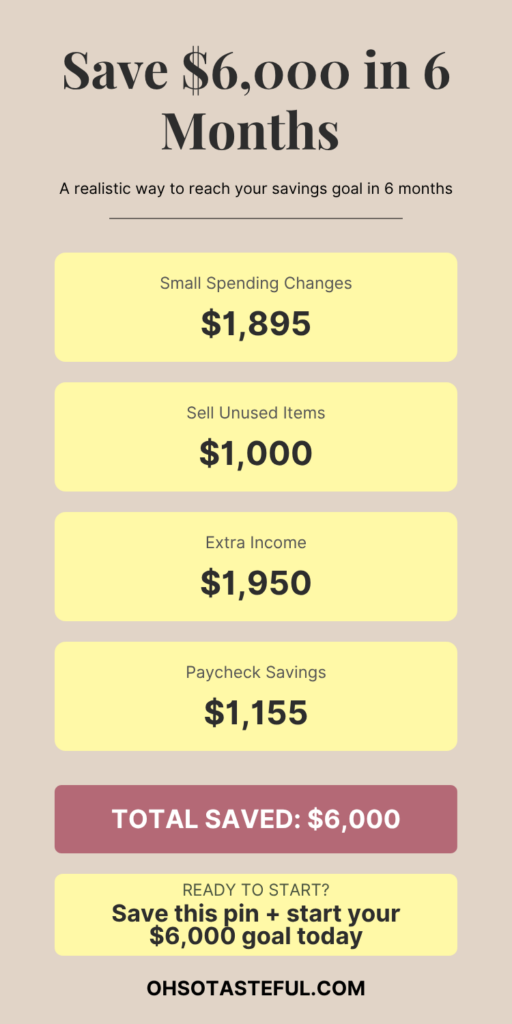
Seeing what this could look like when you put everything together is a plus.
Note, if you bi weekly paychecks are enough that you can save $462 per paycheck then this is not for you.
But, if you decided to tackle the $6,000 saving goal using a combination of spending a little less, earning a little more, and saving consistently, here’s how it would look:
| Method | Amount |
|---|---|
| Small Spending Changes | $1,895 |
| Selling Unused Items | $1,000 |
| Overtime, Extra Shifts, or Side Income | $1,950 |
| Savings From Regular Paychecks | $1,155 |
| Total Saved | $6,000 |
Did you notice that only $1,155 of the goal came directly from regular paycheck savings?
When you spread this across 13 pay periods, that’s only about $89 per paycheck.
The rest is from:
- Making a few small spending changes
- Selling things that were no longer being used
- Bringing in a little extra income over six months
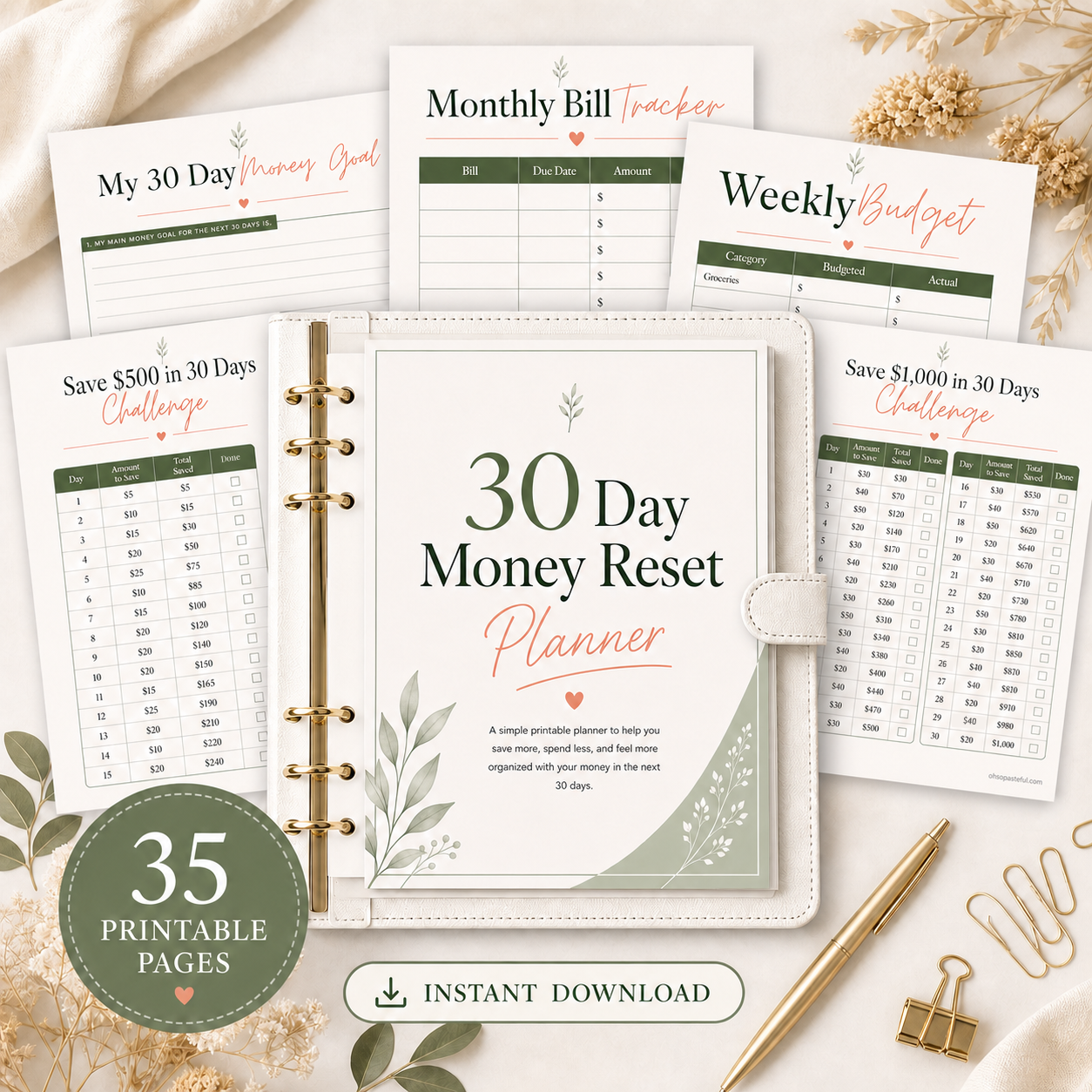
Ready to do more than just save money for 30 days? The 30 Day Money Reset Planner helps you track your spending, plan your bills, cut back on impulse buys, choose a savings challenge, and feel more in control of your money by the end of the month.
It includes budget pages, spending trackers, savings challenges, no-spend pages, weekly check-ins, and reflection pages so you’re not just guessing your way through the challenge.
That’s why I always believe that large savings goals are often more achievable than they first appear even when most people do not.
When most people look at a $6,000 goal they immediately think:
“There’s no way I can save $462 from every paycheck.”
But that’s not actually what this challenge is asking you to do.
The goal isn’t to perfectly save $462 from every paycheck.
The goal is to save $6,000.
And that money can come from a combination of spending less, earning more, selling unused items, and setting aside whatever you can from each paycheck. When you break the goal down this way, it stops feeling like one giant mountain and starts looking like a series of smaller hills that are much easier to climb.
And that’s exactly how most successful savers reach big financial goals in the first place.