Walking every day should be one of the easiest habits to stick to. There’s no complicated routine to learn, you don’t necessarily need a gym, and technically you can get up and start walking whenever you want.
But somehow, it doesn’t always work like that.
You wake up planning to walk later, work gets busy, later turns into much later, and then you check your steps at 7:30 p.m. and realize you’ve barely moved all day. Or you finally have time for a walk, but now you’ve showered, changed into comfortable clothes, and have absolutely no interest in putting shoes on and heading back outside.
I’ve realized that these little things matter a lot more than they seem to.
The actual walking usually isn’t the difficult part. It’s everything surrounding the walk—the getting ready, finding the time, deciding where to go, dealing with the weather, realizing your headphones are dead, or leaving so many steps until the end of the day that walking suddenly feels like another chore you need to finish.
So instead of constantly trying to become more motivated to walk, I think it makes much more sense to make walking ridiculously convenient.
These are 15 little things that can do exactly that.
1. One Pair of Walking Shoes That Basically Lives by the Door
You obviously need comfortable shoes if you’re going to walk regularly, but I think there’s something even more useful than simply owning a good pair of walking shoes: knowing exactly where they are.
Preferably somewhere you can practically trip over them.
There have probably been plenty of times when you’ve thought about going for a quick walk and then realized your sneakers were upstairs, in the closet, underneath something, or wherever shoes mysteriously disappear to when you’re actually looking for them.
Finding them takes two minutes.
But those two minutes are sometimes enough for “I’ll go for a quick walk” to become “I’ll do it later.”
Having one comfortable pair that basically lives beside the door eliminates that entire conversation. You see them, put them on and leave.
And if you walk indoors, do the same thing. Keep the shoes you use for your walking pad right beside it rather than storing them somewhere else.
The less preparation walking requires, the more likely you are to do it when you randomly find yourself with 10 or 15 free minutes.
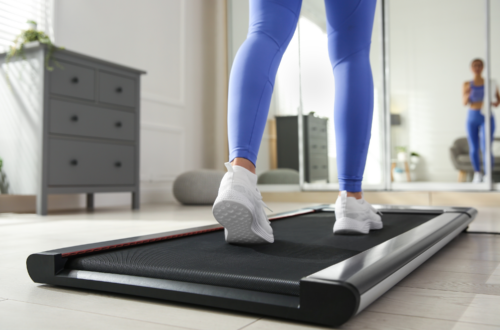
2. A Walking Pad You Don’t Have to Drag Out Every Time
A walking pad can make getting your daily steps so much easier, but I think where you put it matters almost as much as having one.
If you have to pull it out from underneath a bed, move a coffee table, carry it across the room, plug it in, find the remote and rearrange everything around you before you can walk, eventually you’re probably going to decide that sitting down sounds easier.
If possible, keep your walking pad somewhere that makes it easy to use.
It doesn’t necessarily have to sit permanently in the middle of your living room. But if you can keep it beside your desk, underneath a standing desk, near the television, or somewhere you can have it ready in a minute or two, you remove one of the biggest obstacles to using it.
And once it’s convenient, you don’t have to schedule a big walking-pad workout.
You can walk for 10 minutes while checking emails. Get back on for another 15 minutes later. Walk while watching YouTube after dinner. Do another few minutes because you checked your steps before bed and realized you’re closer to your goal than you thought.
That’s where I think a walking pad becomes really useful—not because you suddenly start walking for hours, but because it gives you an easy way to walk when you otherwise wouldn’t.
3. Knowing How Many Steps You Get in 10 Minutes
This is something I think everyone who pays attention to their steps should figure out at least once.
Put on whatever you normally use to track your steps, walk at your normal pace for 10 minutes, and see roughly how many steps you get.
You don’t need to turn it into a scientific experiment. Your number will change depending on your pace, where you’re walking and probably even the day. You just want a useful estimate.
Because “I still have 2,300 steps left” sounds annoying.
But once you know roughly what 10 minutes of walking looks like for you, you can translate that number into actual time.
Suddenly you know whether you can finish those steps during one episode of a show, two short walks around the block, or a little walking-pad session now and another one later.
A remaining step count stops feeling like this vague amount of work hanging over your head.
4. A Tiny Walking Minimum for the Days When You Really Don’t Feel Like It
Your normal walking goal and your minimum walking goal do not have to be the same thing.
In fact, I don’t think they should be.
Maybe you normally aim for 8,000 steps. Maybe you like walking for 30 minutes every morning. Maybe you’re doing a walking challenge.
Whatever your normal routine looks like, decide what the easiest possible version of it is.
Ten minutes.
Five hundred steps.
One walk around the block.
Whatever feels almost too easy to count.
Then use that version on the days when everything has gone wrong.
The point isn’t to pretend that a five-minute walk is exactly the same as your normal 30-minute walk. It’s simply to give yourself another option besides do everything or do nothing.
Because sometimes you genuinely don’t have time for the full thing. Sometimes you don’t feel like it. And sometimes you start with the tiny version and end up walking longer anyway.
But even when you don’t, you did something.
Tomorrow can be a normal day again.
5. A 10-Minute Playlist That Ends When Your Walk Does
Not every walk needs a podcast, audiobook or carefully curated hour-long playlist.
Sometimes I think it’s more helpful to have something that makes a short walk feel complete.
Make yourself a playlist that lasts around 10 or 15 minutes and fill it with songs you actually want to hear. Then when you don’t feel like walking, put it on and tell yourself you’re only walking until it ends.
You don’t have to watch the clock.
You don’t have to keep checking how many minutes you have left.
The music does the timing for you.
And this works particularly well for those little walks you’re trying to squeeze into the middle of a busy day because there is a very obvious finish line.
Three or four songs.
Done.
Anything beyond that is extra.
6. One Boring Walking Route You Know Almost Too Well
I love the idea of discovering new walking routes, but I don’t think your everyday walk needs to be an adventure.
Sometimes boring is incredibly convenient.
Have one route you can walk without thinking about it. You know approximately how long it takes. You know where you’re going to turn around. You know which streets you’re taking. You know whether you can fit it in before work or before dinner.
There is nothing to plan.
When you have plenty of time and feel like exploring, go somewhere new.
But on the days when you just need to get out the door before you change your mind, having a default route removes another decision.
7. A Cheap Pedometer That Counts the Steps Your Phone Never Sees
If you always have your phone on you, this might not matter much.
But if you regularly put your phone down while you’re at home, you could be missing quite a few steps.
Think about how often you walk into the kitchen, put away laundry, clean, go back and forth between rooms, grab something from upstairs, pace during a conversation, or walk around getting ready while your phone is sitting somewhere charging.
Those aren’t huge bursts of activity, but they happen all day.
A basic clip-on pedometer can be useful if you want to track those steps without buying or wearing a smartwatch. Clip it on in the morning and forget about it.
I actually like this because it reinforces something that is very easy to forget when you’re trying to walk more:
The boring steps count too.
You don’t have to deliberately exercise for every single step you get.
8. A Show You’re Only Allowed to Watch While Walking
This is especially good if you own a walking pad.
Pick something you actually want to watch—not something educational you think you should watch—and make it your walking show.
If you want to see what happens next, you have to get on the walking pad.
I think this works better than constantly searching for motivation because you’re attaching walking to something you were already looking forward to.
And if an episode is 30 or 40 minutes, you don’t necessarily have to walk through the whole thing.
Walk for the first 15 minutes.
Or walk until the first ad.
Or get off halfway through and finish the episode later.
The point isn’t to create another strict rule. It’s to give yourself a reason to start.
Starting is usually the annoying part.
9. Somewhere to Put Your Phone and Keys That Doesn’t Drive You Crazy
This is one of those tiny problems you don’t really think about until you’re 20 minutes into a walk and you’re still carrying your phone in one hand because your clothes don’t have pockets.
You don’t need to bring much on an ordinary walk, but the few things you do bring need somewhere to go.
If your walking clothes have good pockets, perfect.
If they don’t, a tiny belt bag or lightweight crossbody can make outdoor walking much more comfortable. Throw your phone, keys and maybe your earbuds inside and forget about them.
I would choose something small rather than turning a neighborhood walk into an expedition where you’re carrying half your belongings.
You want less stuff to think about, not more.
10. Getting a Small Head Start Before the Day Gets Away From You
I don’t necessarily think everyone needs to wake up at 5 a.m. and take a giant morning walk.
But I do think there is something wonderful about not starting the afternoon with 643 steps.
If you have a daily step goal, try getting a small portion of it early.
Maybe you walk for 10 minutes after you wake up.
Maybe you get 1,000 steps before you sit down to work.
Maybe you walk while drinking your morning coffee or spend 15 minutes on your walking pad before you start answering emails.
You aren’t trying to finish your steps.
You’re simply giving your future self less walking to do.
There is a huge psychological difference between checking your steps in the evening and seeing that you need another 2,000 versus realizing you still need another 6,000.
A little morning walking gives you some breathing room.
11. A List of Things You Can Do While You Walk
One of the biggest reasons people struggle to fit walking into their day is that walking can feel like time taken away from something else.
So stop making walking the only thing you’re doing.
Keep a mental list of things that pair well with it.
Call someone you’ve been meaning to catch up with.
Listen to a podcast.
Watch a long YouTube video on your walking pad.
Listen to an audiobook.
Brainstorm something.
Catch up on voice notes.
Take a meeting that doesn’t require your camera.
Watch part of a show.
Even scrolling on your phone can become walking time if you’re safely on a walking pad instead of sitting on the couch doing exactly the same thing.
This is particularly useful when you’re busy because you stop having to “find time to walk.” Instead, you look at something you were already going to spend 20 minutes doing and ask whether you could walk while doing it.
Sometimes the answer is no.
But surprisingly often, it’s yes.
12. An Indoor Backup That Requires Almost No Effort
You need to know what happens when it rains.
Or when it’s ridiculously hot.
Or when you don’t feel like leaving the house.
Or when the walk you planned for lunchtime gets pushed back and suddenly it’s dark outside.
If outdoor walking is your only option, every one of those situations becomes a reason to skip your walk.
So decide on your backup before you need it.
Your walking pad is an obvious option, but it isn’t the only one. You could put on an indoor walking video, walk laps through your house, walk while cleaning, or deliberately pace while listening to something.
It doesn’t have to be as enjoyable as your normal walk.
It just has to be easy enough that you can actually do it.
The best backup plan is usually the slightly boring one that requires absolutely no preparation.
13. Clothes You Can Walk In Without Changing First
This is one of my favorite little walking hacks if you work from home.
Wear clothes you can comfortably walk in.
Not necessarily workout clothes. Just clothes that aren’t going to make you say, “I’ll walk later after I change.”
Because somehow changing clothes can become an enormous obstacle when you only planned to walk for 10 minutes.
If you’re already wearing comfortable shorts, leggings, joggers, a loose T-shirt, or whatever you like walking in, you can randomly decide to hop on the walking pad or take a quick walk without turning it into an entire production.
There are obviously days when this isn’t possible.
But when it is, take advantage of it.
14. A Halfway Checkpoint So You Don’t Discover the Problem at 8 P.M.
Instead of obsessively checking your step count all day, have one loose checkpoint.
For example, if you’re aiming for 8,000 steps, maybe you like being somewhere around 4,000 by mid-afternoon.
It doesn’t need to be exact.
The purpose is simply to catch the days when you’ve barely moved before you’re getting ready for bed.
If you check at 2 or 3 p.m. and you’re at 2,100 steps, that’s useful information. You still have plenty of opportunities to walk. You can take a quick break, get on your walking pad, walk while making a call, or deliberately move a little more throughout the rest of the afternoon.
It’s much easier to correct a low-step day when you still have half the day left.
Finding out at 9 p.m. is a very different experience.
15. Letting Yourself Get Your Steps in the Least Impressive Way Possible
This might be the thing that makes daily walking easiest of all.
Stop requiring your walking to look impressive.
You do not have to get your steps from a beautiful sunrise walk.
You don’t need an hour-long power walk.
You don’t need to walk five miles without stopping.
You don’t even necessarily need to leave your house.
You can get 800 steps walking around while you’re on the phone.
Another 1,000 running errands.
A few hundred while cleaning the kitchen.
Another 1,500 on your walking pad while watching something completely pointless.
You can walk for eight minutes because that’s how much time you have.
You can pace around your house at night because you realized you’re ridiculously close to your goal.
You can take three short walks instead of one long one.
All of it counts.
And once you stop treating walking like it only matters when it happens during an official “walk,” it becomes much easier to fit more of it into an ordinary day.
Walking Every Day Gets Easier When You Remove the Annoying Parts
I don’t think the secret to walking every day is becoming incredibly disciplined.
I think a much more realistic approach is looking at all the tiny reasons you don’t walk and getting rid of as many of them as possible.
If you don’t walk because it’s raining, have an indoor option.
If getting dressed is the problem, wear something you can already walk in.
If you hate seeing thousands of steps left at night, get a small head start in the morning.
If walking feels like wasted time, pair it with something you were already going to listen to, watch or do.
If your phone misses half your movement, use a pedometer.
If getting your walking pad out is a hassle, find a way to keep it more accessible.
None of these things is revolutionary on its own, and that’s actually the point.
When you’re trying to make something part of your everyday life, the little inconveniences matter. Remove enough of them and walking stops being this extra thing you have to motivate yourself to do.
It simply becomes one of the things you do throughout your day.
And that is a much easier habit to keep.