

All those money saving challenges sounds incredibly simple when someone else explains it, don’t they?
Just put $100 into savings every payday. Stop buying coffee. Cancel a few subscriptions. Cook at home more often. Set up an automatic transfer and then pretend the money isn’t there.
And while that advice is really useful, it’s assuming there is actually extra money sitting around waiting to be saved.
This is all well and good if your income can support it. You can just find ways to weed out excess spending which makes it easier for you to find and save $100 or even $200 every week.
But when you’re living on a lower income, that isn’t always the case.

In those cases, you can do everything right and still have a month where the electric bill is higher than expected, groceries cost more than you planned, somebody needs new shoes, the car needs something, or three completely ordinary expenses decide to show up during the exact same week.
This is just a part of every day life for many people and isn’t much you can really do about it. But, this is exactly why I don’t think a low income money saving challenge should be built around saving some huge amount of money every week.
If money is genuinely tight, trying to force yourself to save an amount you can’t afford usually ends with you transferring the money right back out of savings a few days later, thus defeating the purpose.
This is why this challenge is built differently.
Instead of starting with an impressive savings goal, we’re going to start with finding small amounts of money that can realistically stay saved.
Some weeks that might be $5 and other weeks it might be $30.
And every once in a while, you might have one of those glorious little weeks where nothing unexpected happens and you can put away $50 or more. But, we’re sticking to smaller numbers that we can actually save here.
While not impressive for most people, this does two very important things. First, you’re actually saving this money long term. Not having it look good in your savings account for 1 or 2 weeks tops. Second, it helps you build that consistent saving habit. After all, you may now remain low income for ever. You may get a better job down the line, or you may get a raise, or you may end up starting a business or side hustle that skyrockets your income. And you’ve already mastered that habit of saving consistently, then you can truly set yourself up well financially.
But, enough of this. Let’s see how you can successfully do a low income money savings challenge even if you might be living paycheck to paycheck.

Before You Start A Low Income Money Saving Challenge
This is all you’ll need to do. For the next 30 days, your goal is to find at least one small amount of money to save every day, without taking money away from necessities.
There is no required daily amount, but, if you need some guidance, here’s some ideas to choose from.
$1 • $2 • $3 • $5 • $10 • $15 • $20
Every day, look at your finances and choose the amount that makes sense.
If it’s a particularly tight day, save $1. If you planned to spend $8 on something and decided you didn’t need it, save $5. If payday came and you have a little breathing room after your bills are covered, maybe you choose $10, $15 or $20.
The most important thing here is that you’re not randomly picking a number and hoping you can survive without it. I order for this to work, you need to deliberately look at the money you have and decide what can safely be moved aside without you having to pull it back out for necessities.
Because of this, some days, you won’t be able to save any money at all. After all, this is real life. It is better to skip that day or save just $1 if you don’t want to break your streak, instead of saving $10 and then have to use a credit card to buy groceries or pulling it back out three days later.

Easy 30 Day Low Income Savings Challenge
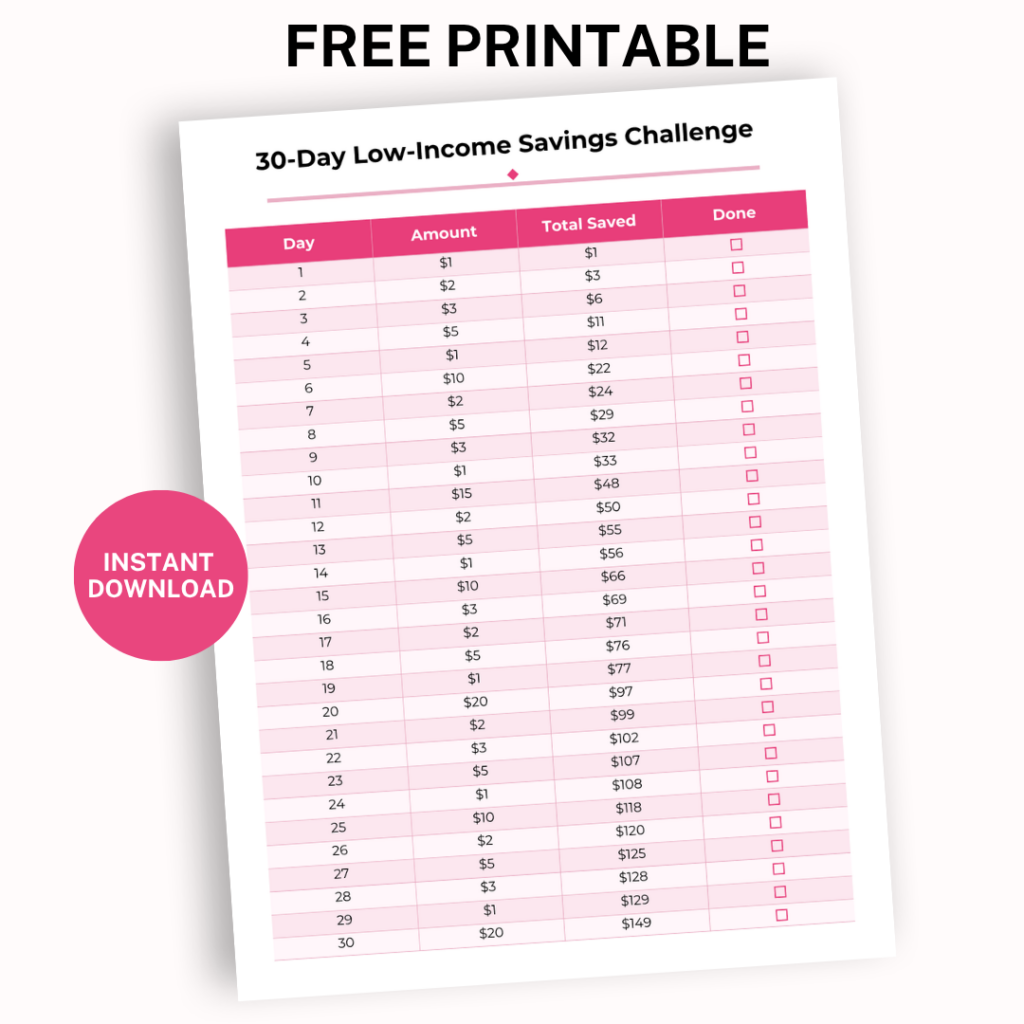
Here is one way the month could look:
| Day | Amount |
|---|---|
| 1 | $1 |
| 2 | $2 |
| 3 | $3 |
| 4 | $5 |
| 5 | $1 |
| 6 | $10 |
| 7 | $2 |
| 8 | $5 |
| 9 | $3 |
| 10 | $1 |
| 11 | $15 |
| 12 | $2 |
| 13 | $5 |
| 14 | $1 |
| 15 | $10 |
| 16 | $3 |
| 17 | $2 |
| 18 | $5 |
| 19 | $1 |
| 20 | $20 |
| 21 | $2 |
| 22 | $3 |
| 23 | $5 |
| 24 | $1 |
| 25 | $10 |
| 26 | $2 |
| 27 | $5 |
| 28 | $3 |
| 29 | $1 |
| 30 | $20 |
Total saved: $149
This is just an example and can be tweaked to suit your needs.
So, just think of the chart as a starting point rather than a rulebook. If Day 20 arrives and there is absolutely no way you’re putting $20 into savings, swap it for one of the $1 days. Similarly, If you get paid on Day 8 and realize you can comfortably save $20 instead of $5, do that.
This low income challenge should bend around your life, not the other way around.
Want To Try This Challenge? Grab The Free Printable
If you want to give this challenge a try, I made a FREE 30-Day Low Income Savings Challenge printable that you can use to follow along.
Print it out, keep it somewhere you’ll actually see it, and mark off each amount as you save it.
GET THE FREE SAVINGS CHALLENGE →
Start With $1 Instead of Waiting Until You Can Save $100
I think one of the biggest things that keeps people from saving on a lower income is the feeling that tiny amounts aren’t worth bothering with.
It’s too easy to look at your bank account and think, What is $3 going to do?
And to be fair, $3 isn’t going to build an emergency fund overnight.
But that’s not really what you should be trying to accomplish with that first $3. You’re simply trying to build the habit of separating money you have available to spend from money you’re intentionally keeping.
And that distinction really matters because if you wait until you’re earning enough to effortlessly save hundreds of dollars every month, you could end up waiting a very long time or sometimes not starting at all.
It’s better to start today with just $1 or $3, make the habit something you do almost instinctively, get about $100 saved every month, then later when or if you start to earn more, saving more just comes so naturally to you. That’s a real win.
Great ways to find money to save on a low income
Use Money You “Didn’t Spend”
This is probably my favorite way to make this low income savings challenge work without feeling like you’re constantly taking money away from yourself.
Whenever you were going to spend money but didn’t, save at least part of it.
Let’s say for instance you almost ordered takeout but ended up making something at home instead. If so, you just avoided spending $25. You don’t necessarily need to transfer the entire $25 into savings since your grocery budget probably paid for the food you ate at home anyway.
But could you move $5? Or maybe even $3?
Probably.
Maybe you were about to buy something online and changed your mind.
Move $3.
Find other ways you can do this in your own day to day life. Then try doing this when you’re find it hard to save those extra dollars throughout the challenge.
Doing it this ways makes saving into something you notice throughout your normal life instead of another expense fighting for space in an already tight budget.
Look for Money That Is Already Slipping Through
I’m not going to tell you that cutting a $5 expense will magically transform your finances. But when money is tight, I do think it’s important to look a little more closely at those small charges that have become so normalized you barely notice them anymore.
Open your bank statement and actually read through it.
Not your budget. Because for most people, a budget is usually what you want to happen to your money rather than what actually happens to your money as the month goes by.
So, look at your real bank statement to see what’s really happening.
Look out for subscriptions you’ve forgot about, little convenience purchases, delivery fees, app charges, bank fees, repeat purchases and anything else that makes you stop and think, Wait…I’m still paying for that?
You don’t need to eliminate every enjoyable thing from your life. Just try to find those expenses that aren’t giving you enough value to justify what they’re costing you.
And, even if you only end up finding $12 here and $8 there, this could give you another $20 to put toward this low income savings challenge.
Have One “Use What We Have” Day Every Week
Once a week, try to get through the day without buying anything you didn’t already plan to buy. By the way, I’m not saying that you can’t pay a bill or buy something necessary.

But before you spend money, you should check whether there is already a reasonable alternative at home. For example, on that day you can, make dinner from what is already in the freezer, only have drinks from home, wear something you already own for a special occasion etc.
You’d be surprised how often spending happens simply because buying something new is easier than working with what you already have.
If you do this successfully, move $1–$5 into your challenge savings.
Make Payday Your Bigger Savings Day
If you’re going to have any of those $10, $15 or $20 days in this challenge, payday is probably the best time for them.
And if you can help it, don’t wait until the end of the pay period to see what’s “left over” before you save. I’ve found that this usually doesn’t work very well because money has a funny way of finding somewhere to go when you haven’t already decided where you want it to go.
Instead, once you’ve accounted for your necessary bills and realistic living expenses, look at what you have available and decide what you can comfortably move into savings right then. Maybe that’s $10. Maybe it’s $15 or $25. If this happens to be a particularly tight paycheck, it might only be $5. That’s okay too.
But once you’ve decided that you can afford to save that amount, be strict about actually moving it. Don’t leave the $15 sitting in your checking account with the intention of saving it later. Later is when something you weren’t planning to buy suddenly starts looking affordable because there’s still money sitting there.
Payday might be the one day—or one of only two days this month—when you’ll have the most money available to you at once. Your necessities absolutely come first, but once those are accounted for, give your savings goal a place in line too. Move what you realistically can while you actually have it, rather than hoping some of it will still be hanging around two weeks from now.
Keep Your Challenge Money Somewhere Separate
This is one thing I would absolutely do if you’re serious about making this challenge work. Do not let your challenge money sit mixed in with your everyday spending money if you already know you’re likely to accidentally spend it.

Put it into a separate savings account, savings bucket, cash envelope or whatever separate place works best for you. Because $87 sitting in your checking account can very easily start looking like $87 you have available to spend—even though you’ve technically already decided to save it.
For me, strangely enough, physical cash works really well for savings challenges.
It’s definitely more tedious. I have to withdraw the money, bring it home and physically put it away rather than simply transferring it between accounts. But I’ve been doing this with some of my savings for the past few years, and I’ve realized that the inconvenience is actually part of why it works so well for me.
When extra money is sitting in one of my accounts, it’s incredibly easy to spend. I can be lying in bed, see something I absolutely do not need online and have it ordered within two minutes. There is almost no friction between I want that and I bought that.
But if that same $50 is physical cash I’ve already put away for a savings challenge? Now I’d have to make the deliberate decision to go get that money, take it out of where I’ve saved it and turn it back into spending money. Apparently, that’s just inconvenient enough to make me leave it alone.
I still keep savings in the bank, of course. But for some of the smaller amounts I accumulate through savings challenges, I like using physical money buckets or a sealed savings jar at home because making the money slightly harder to access makes it much harder for me to spend impulsively.
You absolutely don’t have to do it this way. In fact, if keeping cash at home doesn’t feel secure or practical for you, don’t. A separate savings account or savings bucket can accomplish the same basic thing.
The method isn’t really the important part. The separation is.
Once you’ve decided that $5, $10 or $20 belongs to this challenge, put it somewhere that doesn’t make it look like everyday spending money anymore.

This SKYDUE Budget Binder is perfect if you prefer cash savings because you can separate your money into zipper envelopes and label each one by category or goal. Use it for your 30 day savings challenge, grocery budget, bill money, sinking funds, or weekly spending cash.
It makes the challenge feel more visual and satisfying because you can watch each envelope fill up as you save.
Give The Money A Specific Job
One way to make this challenge stick is to give it a purpose. If you tell yourself that you just want to save more more, chances are you can lose that motivation to keep going pretty quickly.
But if you say you want to:
- Save your first $300 emergency cushion
- Save enough to cover your car insurance renewal
- Save $250 so Christmas doesn’t destroy December’s budget
Then these are more tangible ideas that you can work with.
So before you start this challenge, write down exactly what you’re saving for. It doesn’t need to be something big or even exciting either. Just what will work for your own life.
Don’t Restart The Challenge Every Time You Miss A Day
Like working out, many people tend to give up on a savings challenge if they miss a day or two. Don’t let that be you.
You will miss days. Just continue on the next day.
And if you have a week where everything goes wrong and you can’t save anything at all, leave your existing savings alone if possible and pick the challenge back up the next week..
Saving $73 during a difficult month is still $73 you didn’t have before. Same as saving $28 is still $28.
The challenge doesn’t become pointless simply because you didn’t hit that perfectly number.
Try To Find One Bigger Win During The Month
Most of this challenge focuses on very small amounts because those are easier to fit into a tight budget. But during the month, I also want you to look for one bigger opportunity.
Some ideas you can try are as follow:
- Try to sell something you don’t use anymore and make $60.
- Consider cancelling an annual subscription before it renews.
- Shop your car insurance and reduce the bill, then save the balance.
- Use a grocery coupon, store reward or rebate and move the amount you saved into your challenge fund.
- Pick up a small amount of extra work.
One $50 win can do more quite a lot for challenge, so keep your eyes peeled for such opportunities too.
What If You Truly Can’t Save Anything Right Now?
Then I wouldn’t force it for now. Everyone’s finances is different and so there are situations where income is simply too close to — or below — essential expenses. If you’re already in this situation where every dollar is already going toward housing, utilities, transportation, groceries, debt minimums and other necessities, the answer isn’t necessarily to squeeze another $20 out of yourself.
Your version of this low income saving challenge my temporarily need to become a money-finding challenge instead.
Here’s how I’d approach this:
For 30 days, track where your money actually goes.
- Look for expenses you can eliminate.
- Call and negotiate bills where possible.
- Sell unused things.
- Plan meals around what you already have.
- Check whether you’re paying unnecessary fees.
- Look for assistance, benefits or programs you may qualify for.
- Find one small way to increase income.
Then, when you finally create that first $5 or $10 gap between what comes in and what goes out, that’s the money you start saving.
Because then you can be sure that you’re not just trying to make bank account look impressive for 24 hours. But, you’re creating savings that stay there.
A Few Rules I Would Follow During This Challenge
Saving money on a low income can be genuinely difficult, and I think that’s important to acknowledge before getting into these rules.
Sometimes the problem isn’t that you’re spending hundreds of dollars every month on things you could easily cut out. Sometimes, after rent or your mortgage, groceries, utilities, transportation and all the other things you actually need are paid for, there simply isn’t that much money left.
And that’s exactly why I don’t want you approaching this challenge as if the only thing that matters is hitting a certain savings number.
If you have $500 of genuinely disposable income every month, you have quite a bit of room to move things around and decide what you’re willing to give up in order to save more. If your budget only has $75 or $100 of breathing room—and sometimes less—you have much less room for error. Saving too aggressively could simply mean having to pull the money back out a week later when you need groceries or your electricity bill comes in.
So, for this particular challenge, I think a few rules matter more than anything else. If you stick to them, you have a higher chance of saving on a tight budget in a sustainable way. Keep these in mind as you embark on this challenge:
Don’t borrow money so you can save money. If putting $20 into savings means you’re going to charge $20 of groceries to a credit card, that isn’t really saving.
Don’t punish yourself for choosing a smaller amount. A $1 day is part of the challenge too.
Don’t raid the savings for ordinary spending. Once you’ve moved the money, try to mentally mark it as unavailable unless you genuinely need it.
Do save unexpected money when you can. A refund, rebate, small bonus, cash gift or money from selling something can give your challenge a nice boost.
Do adjust the challenge to your income. Someone earning $1,800 a month shouldn’t necessarily be following the exact same savings schedule as someone earning $4,500.
And most importantly, don’t turn this into another reason to feel bad about money.
This is supposed to help you create a little more breathing room, not make an already stressful situation feel worse.
How Much Can You Actually Save?
If you followed the sample challenge exactly, you’d finish with $149. But I’d actually consider the challenge successful if you finished with $50. Or $87. Or $113.
If you were able to save more because you happened to find a few bigger savings opportunities along the way, even better.
I’m saying this to say that your final number is going to depend on your income, expenses and what happens during those 30 days.
What matters more that how much you saved is whether you finish the month with more money set aside than you started with. And once you finish, you can do something even better.
Start another month.
Even if you didn’t quite hit the number you wanted in that first month, you can try again and again.
Maybe your first challenge may end with $75
The second ends with $126.
The third ends with $93.
The forth ends with $160
The fifth with $144
The sixth ends with $123
In total that is $721 that you did not have saved before!
And, if you followed some of my tips above, you did not have to do it while living on rice for a month since you did it by finding small amounts of money and protecting them.
For someone trying to build savings on a lower income, I think that’s a much more useful challenge than pretending every household has hundreds of dollars sitting around waiting to be saved.