

You know that awful feeling you get when you’re about to check your bank account and your stomach does that little drop? That anxiety you get because you’re worried about what your money will be telling you.
Not because you bought one huge thing. Not because you did anything really wild. But because somehow, you know that that money is gone…or mostly gone.
And the worst part is, you can’t even point to one big thing that explains why it’s gone.
Because it was probably groceries. It was probably grabbing some takeout on a tired night. It was definitely that one subscription you completely forgot about. It was that quick Amazon order you couldn’t pass up. It was the extra stop at the store. It was the real quick purchase you grabbed on Tuesday. It was the bill you knew was coming but still somehow didn’t feel ready for. All everyday things that aren’t huge purchases at all.
So now you’re sitting there, forcing yourself to do the mental math, and trying your best to stretch what’s left until the next payday.

And honestly? Modern life makes this kind of SO easy. It’s like the perfect storm, which is why I think most people need to do a money reset.
Not because they’re irresponsible. Not because they’re bad with money. But because financial chaos usually happens quietly, and once overspending becomes a pattern, it can start to feel like your money is controlling you instead of the other way around.
What Is A 30 Day Money Reset?
A 30 day money reset is basically a focused month where you intentionally try to clean up your money habits and start paying closer attention to where your money is actually going.
You’ll spend the next 30 days:
- tracking spending
- reducing unnecessary purchases
- noticing emotional spending patterns
- organizing bills
- planning meals
- checking subscriptions
- setting savings goals
- building small systems that make life easier
The goal is not to be perfect with your money. That’s impossible and most of us don’t even want that.
You are simply trying to manage your money more intentionally throughout the month so it doesn’t all disappear and leave you desperately waiting for the next month to do that all over again.
And believe me, once you start noticing your individual money patterns, things often start feeling calmer surprisingly fast.
Signs You Probably Need A Money Reset
Some signs that a money reset might help:
- You keep wondering where your money went at the end of every month— every month. This is SO exhausting.
- You avoid checking your subscriptions because you already know there’s nonsense hiding in there somewhere.
- You mentally calculate your account balance before buying things because you’re not fully confident what the number actually is.
- You spend more money when you’re stressed, tired, bored, overwhelmed, emotional, or even mildly inconvenienced.
- You order food because “there’s nothing to eat,” despite having groceries at home that technically are food.
- You buy little things constantly because you think that they don’t cost that much — believe me, these add up big time.
- And perhaps most importantly, for months, you’ve been telling yourself that you’re going to spend less money THIS month but that promise falls apart by day three of each month.
Stop Hiding From Your Money
One of the biggest signs that your finances are stressing you out is avoidance.
The tricky thing is that financial avoidance doesn’t always look dramatic. Most of the time, it shows up in small everyday ways that seem harmless at first. You put off checking your bank account until tomorrow. You ignore an email about a bill. You stop tracking your spending because you already know you’ve gone over budget and don’t really want to see the damage.
Maybe you’ve even caught yourself saying, “I’ll deal with it this weekend,” only for that weekend to come and go without ever opening your banking app.
Before long, you’re making money decisions based more on anxiety than actual information. Instead of knowing where you stand financially, you’re guessing. And let’s be honest—that guessing usually makes everything feel worse.
I think a lot of people assume that getting better with money starts with having more discipline or willpower. But in reality, it often starts with something much simpler: being willing to look at what’s happening without immediately judging yourself for it.
That’s why the first step of any money reset is awareness.
Now seeing the numbers won’t magically fix your finances overnight. Your credit card balance won’t disappear, and your savings account won’t suddenly double. But once you know exactly what’s going on, you can actually make a plan.
The truth is that most money problems feel bigger in our heads than they do on paper. When we avoid looking, our brains fill in the blanks with worst-case scenarios. We imagine we’ve spent more than we have, saved less than we should, and completely ruined our progress.
Sometimes the numbers are better than you expected. But, sometimes they’re worse too. Either way, you’re no longer carrying around the stress of not knowing.
And that alone can feel like a huge relief.
See Where Your Money Really Stands
Once you’ve opened that banking app and faced the numbers, don’t jump straight into a strict budget.
Start with a simple money snapshot.
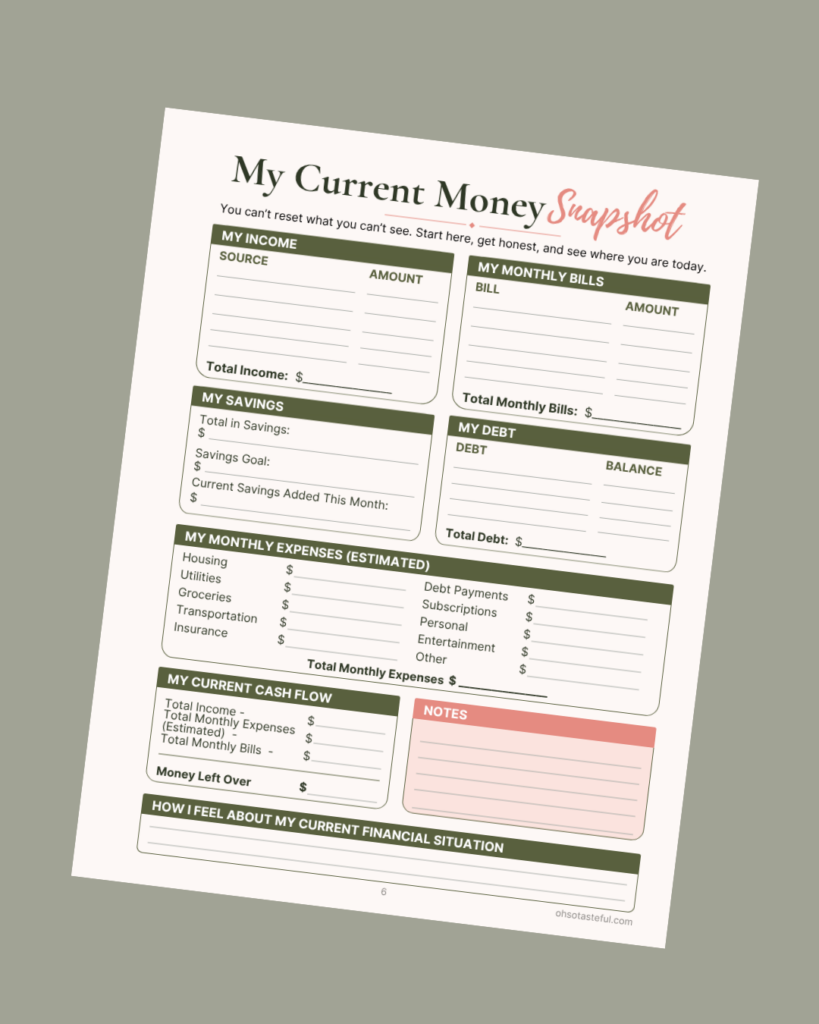
Think of this as taking inventory before you try to fix anything. You’re not judging yourself, punishing yourself, or making some intense new me plan. You’re just writing down what’s actually true right now.
That means looking at your income, monthly bills, debt, savings, subscriptions, regular expenses, and the spending categories where most of your money tends to slip away.
This is exactly why I included the My Current Money Snapshot page in the planner. Seeing everything in one place can make you realize your finances aren’t nearly as chaotic as they feel in your head.
You may not love every number you write down, and that’s okay. The goal is not to feel instantly amazing about your finances.
The goal is to finally know where you’re starting from so you can stop guessing and start feeling more in control of your money again.
The Money Leaks That Quietly Drain Hundreds Every Month
One thing that surprised me when I first started paying attention to my spending was realizing that the problem usually wasn’t one giant purchase.
It was dozens of small ones.
The annoying thing about money leaks is that they’re easy to justify because none of them feel serious in the moment.
For example:
- A $6 coffee three times a week = about $936 per year
- A $15 streaming service you forgot about = $180 per year
- A $25 impulse purchase every week = $1,300 per year
- One extra $40 takeout day each week = over $2,000 per year
- A $10 “little treat” three times a week = more than $1,500 per year
None of these purchases are life-changing individually. But together? That’s thousands of dollars leaving your bank account every year.
And most people never notice this because the spending happens in tiny pieces which is exactly why tracking your money matters so much.
Because you cannot fix spending leaks you can’t see.
The Real Reason You Keep Overspending
You may not believe me now, but a shocking amount of spending has absolutely nothing to do with needing things and is all emotional.
Most times people spend because they’re:
- stressed
- bored
- overwhelmed
- tired
- procrastinating
- emotionally drained
- trying to reward themselves
- trying to feel productive
- trying to feel better
- trying to feel in control
Sometimes spending is a sort of emotional support and you don’t even notice it. I realized this myself after noticing how often I suddenly “needed” something after a stressful week. Not even big purchases either. Just random little things that made life feel slightly easier or more exciting for a few minutes.
Things like a new notebook, my favorite snacks, storage containers, some hyper-specific kitchen gadget I was fully convinced would transform my life…it did not.
You may even start to notice small patterns like:
- ordering takeout after hard workdays
- online shopping late at night
- overspending at Target when you’re overwhelmed
- buying self improvement products instead of resting
- stress spending during hormonal weeks
- buying random snacks every time you leave the house
Once you notice your patterns, they become impossible to unsee.
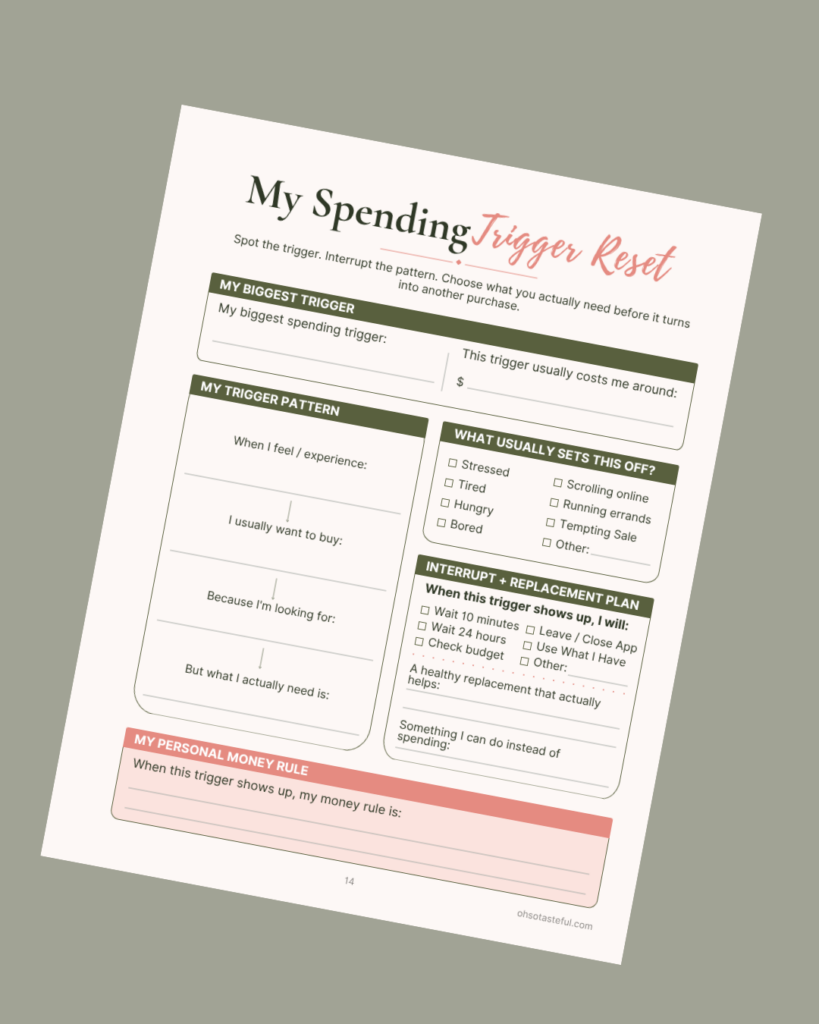
That’s why the My Spending Trigger Reset page in the planner is so helpful. It helps you identify:
- what triggers your spending
- what you usually buy
- what feeling you’re actually chasing
- and what you can do instead before the spending spiral starts
This page is so important because it helps you catch the spending before it happens. And honestly, that’s where a lot of financial control comes from—not being perfect, but being aware enough to interrupt the pattern before your money leaves your account.
Food Is One Of The Easiest Places To Overspend
Food spending alone can quietly wreck a budget… it does that to most budgets actually.
And it gets even worse when life gets busy. One coffee here, one quick lunch there, one little treat you clearly deserve after a long day, one grocery trip with no plan while you’re hungry. And suddenly, your weekly food budget is almost double what you planned for.
The frustrating part is that you can always find a way to justify food spending because it is technically essential and you do need it to survive. Unfortunately, your brain sometimes interprets this as an order of loaded tacos, mozzarella sticks, and a $9 iced drink.
The easiest way to reduce food overspending is to reduce the friction before the chaos hits. You want to have easy meals available before you get tired, stressed, or overwhelmed, because that is usually when the budget start to expand uncontrollably.
That might mean prepping ingredients in advance, being diligent about freezing leftovers, portioning snacks, planning simple meals in advance, grocery shopping with a list and a budget, or keeping backup freezer meals available.
The Simple Meal Plan page inside the planner helps with this so much because it helps you stop relying on last-minute decisions when your energy is already low. And, you can save over $100 per month by making a food budget you actually stick to and by planning out your meals — meals you actually like by the way, so you’ll eat the food you paid good money for instead of ordering takeout when you can’t piece a real meal together from those random groceries that looked realistic in the moment aren’t actually.
By the way, you’re not expected to be perfect here, but even avoiding a few of those chaotic takeout-heavy days during the month can make a big difference.
A typical takeout-heavy day can easily cost $30–$50 between coffee runs, lunch, dinner, delivery fees, and tips.
- Morning coffee = $6
- Lunch = $12
- Dinner takeout = $18
- Fees/tip/extra drink = $6
Total = $42
Therefore, avoiding just one or two of those days each week could save you roughly $120+ per month or $1400+ per year.
And that is the main point here.
There is no need for you to never order takeout ever again. And you definitely don’t need to meal prep 47 containers every Sunday if that’s not your thing.
Just skipping takeout a few days this month will help you cut down on food overspending by a lot.
Why Most People Fall Off Financial Goals So Fast
We all set these goals each month, but some of us never get past the setting the goal stage because we tend to rely on feeling motivated instead of finding workable systems.
Trying to remember spending limits, bills, due dates, savings goals, subscriptions, no-spend rules, meal plans and financial habits in the midst of the other 200 things that life throws at you every day feels impossible.
And honestly, this is where most money goals die.
Not because people don’t care.
Not because they’re lazy.
But because they’re trying to keep their entire financial life inside their head while also remembering work deadlines, grocery lists, family responsibilities, appointments, passwords, laundry, birthdays, and the other 200 things life throws at them every week.
Eventually something gets dropped.
And unfortunately, it’s often the money goals.
That’s why having a physical system helps so much…in all aspects of your life.
I mean writing things down does not magically create money or make you spend less of it, but having some structure helps to reduces some of that mental clutter. Which in turn makes things easier to remember, reference or even stick to since you’re not trying to hold your entire financial life in your brain at all times on top of all the other things life can throw at you.
I think this is probably the biggest strength of my 30 Day Money Reset Planner.
Instead of waking up every day trying to “be better with money,” it gives you the opportunity to simply work through the pages daily:
- spending trackers
- no-spend challenges
- savings goals
- meal planning
- spending trigger resets
- bill tracking
- subscription audits
- weekly check-ins
- monthly reflections
Just print those pages, fill them in and follow the next step.
Every time I’ve ever stopped doing something that I know is beneficial to my life, it has been because it was too overwhelming to keep up with it on top of everything else. And feeling overwhelmed by adding that extra to my life overshadowed the usefulness of the thing.
I made the planner so that it doesn’t feel like too much extra work. Just a few minutes here and there to get your mind right about what you need to focus on for the day for your longer term goal.
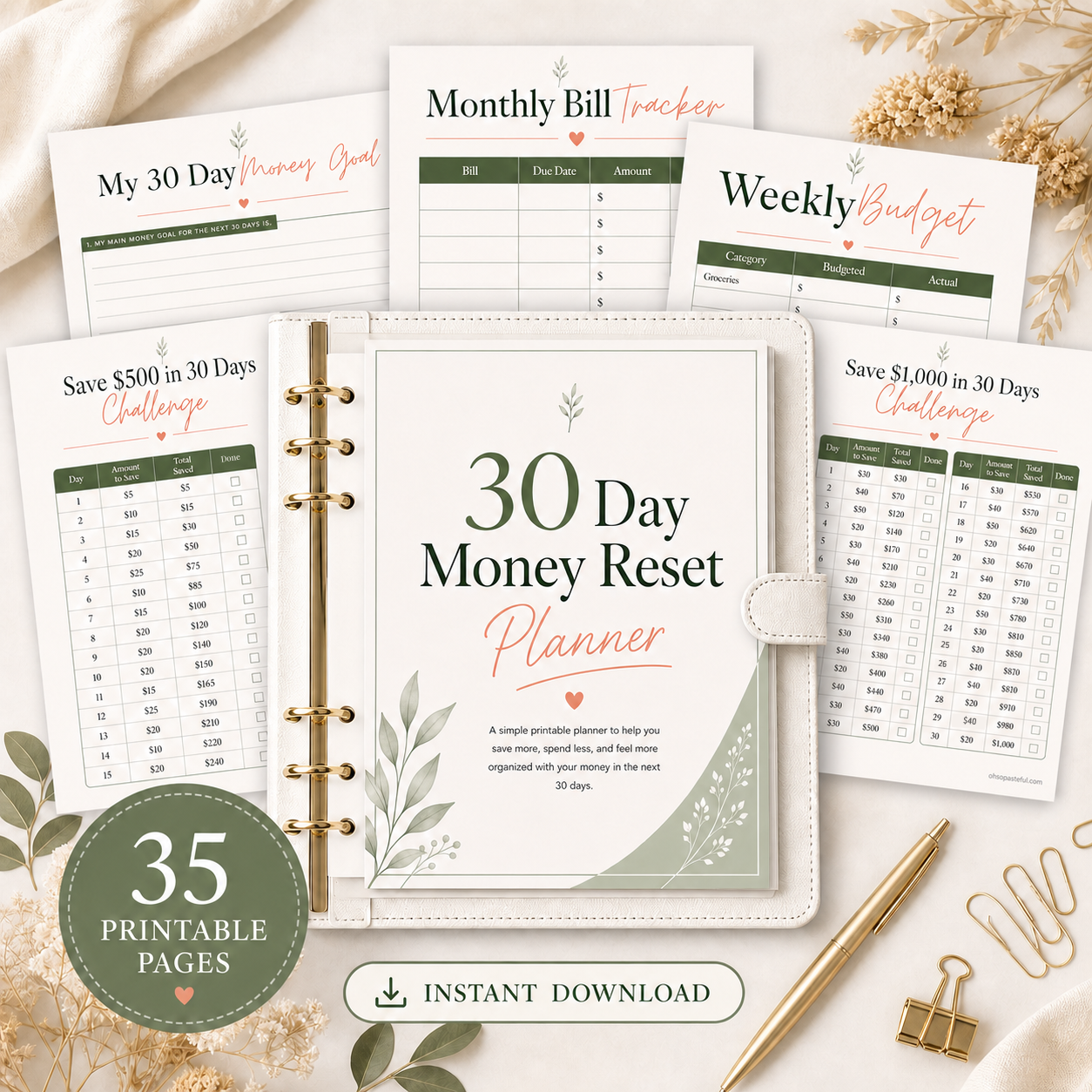
Ready to do more than just save money for 30 days? The 30 Day Money Reset Planner helps you track your spending, plan your bills, cut back on impulse buys, choose a savings challenge, and feel more in control of your money by the end of the month.
It includes budget pages, spending trackers, savings challenges, no-spend pages, weekly check-ins, and reflection pages so you’re not just guessing your way through the challenge.
If there’s one thing I hope you take away from this article, it’s that fixing your spending doesn’t have to mean making your life miserable.
You don’t have to cancel every subscription, swear off restaurants forever, stop buying coffee, or spend your weekends clipping coupons and eating plain rice.
Most of the time, overspending isn’t caused by one giant mistake. It’s usually the result of dozens of small decisions made when we’re mentally exhausted, stretched thin, distracted, emotional, or simply trying to make life a little easier.
That’s why lasting change rarely comes from extreme restrictions.
Instead, it comes from awareness. and it comes from building simple systems that make the right choice easier.
The good news is that you don’t need to fix everything today, or have a perfect budget or become a completely different person.
You just need a starting point.
That’s exactly why I created the 30 Day Money Reset Planner. It was made to help you organize your finances, spot spending leaks, create better habits, and feel more in control of your money without relying on guilt, shame, or extreme budgeting.